
Close
Connect Close, choose the default sync behavior, and map Aura lifecycle events to your Close pipeline stages
Close
Connect Close to keep people, calls, and opportunities current without manual CRM updates.
Aura creates or matches people in Close, adds booking and call activity, and can move the related Close opportunity when an Aura event occurs. Updates made to contacts in Close can also flow back into Aura.
Can Aura move an opportunity in Close?
Yes. Open Pipeline mapping and choose the Close pipeline stage that corresponds to each Aura lifecycle event.
For example:
| Aura lifecycle event | Close destination |
|---|---|
| Lead captured | Sales pipeline / New lead |
| Interested | Sales pipeline / Interested |
| Qualified | Sales pipeline / Qualified |
| Disqualified | Sales pipeline / Disqualified |
| Booked | Sales pipeline / Call booked |
| Rescheduled | Sales pipeline / Call booked |
| Cancelled | Sales pipeline / Lost |
| Won | Sales pipeline / Won |
| Lost | Sales pipeline / Lost |
Aura moves the existing Close opportunity when a mapped event occurs. Choose Do not sync when Aura should leave the opportunity in its current stage.
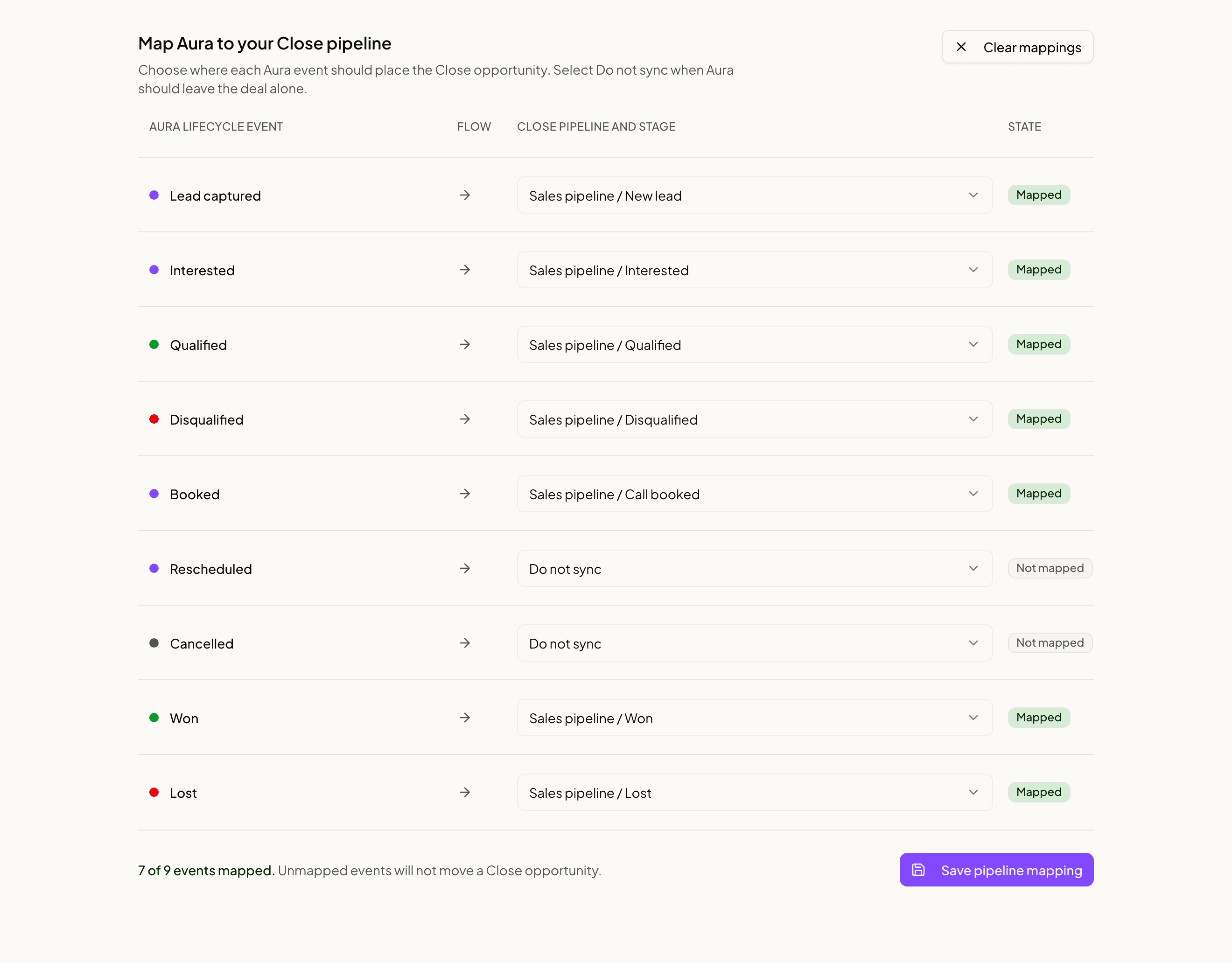
Aura reads the pipelines and stages that already exist in Close. It does not create, rename, or delete your Close pipeline stages.
Connect Close
You must be an Aura organization admin.
- Go to Settings and select Integrations.
- Open Close.
- Select Connect Close.
- Sign in to Close and choose the organization you want to connect.
- Approve access for Aura.
Aura returns you to the integration page, registers the inbound webhook, and reads your current Close pipeline metadata.
Configure the integration
The connected integration has two configuration tabs.
1. Default sync
Use Default sync for the normal day-to-day behavior of the integration.
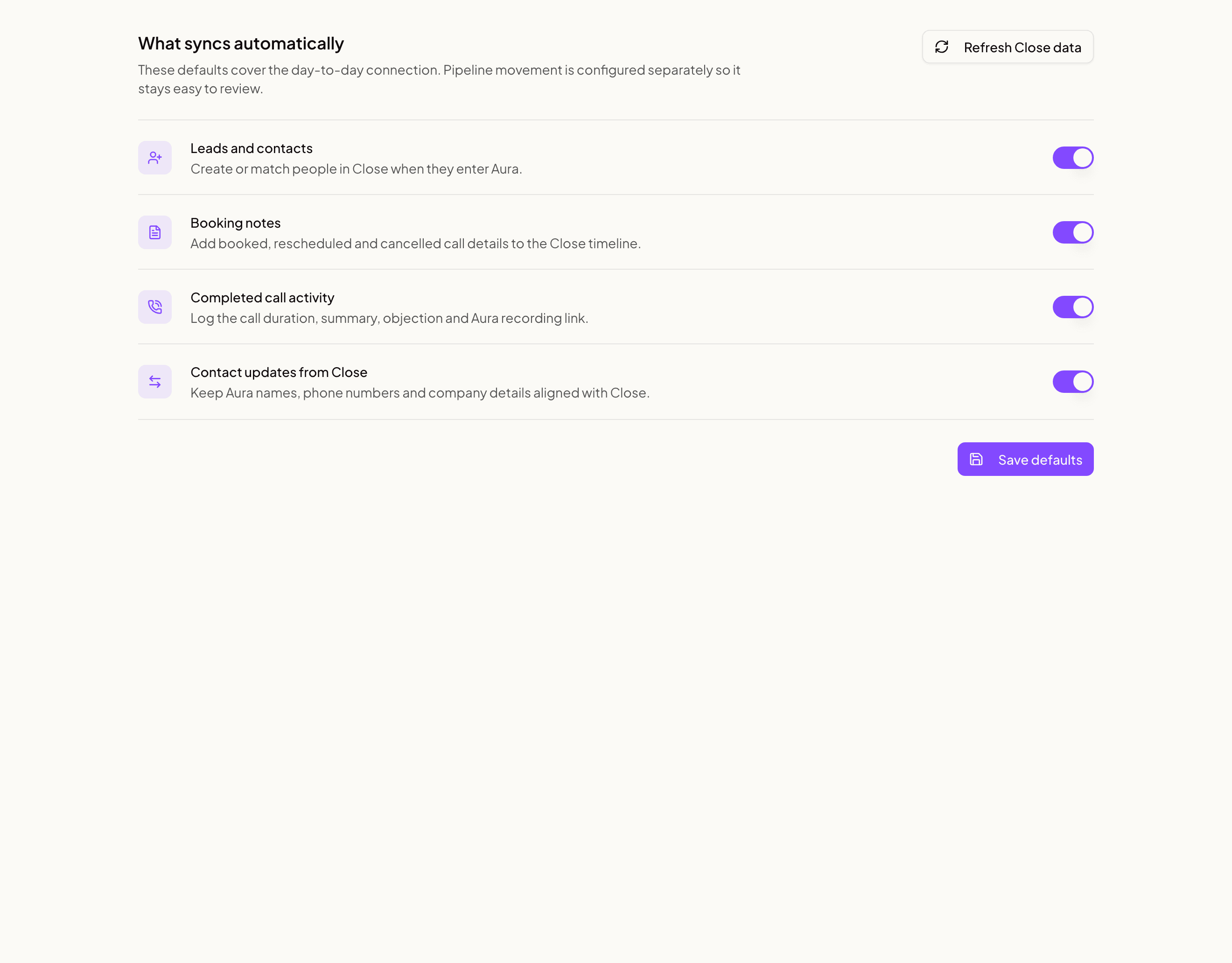
| Setting | What it controls |
|---|---|
| Leads and contacts | Creates or matches people in Close when they enter Aura |
| Booking notes | Adds a Close timeline note when a call is booked, rescheduled, or cancelled |
| Completed call activity | Logs a completed call and its Aura context in Close |
| Contact updates from Close | Applies supported contact and lead edits from Close back into Aura |
Select Save defaults after changing a setting.
Use Refresh Close data after you add or rename pipeline stages in Close. This reloads the available pipelines and stages for the Pipeline mapping tab.
2. Pipeline mapping
Use Pipeline mapping to control opportunity movement.
- Find the Aura event in the left column.
- Select the corresponding Close pipeline and stage in the right column.
- Repeat for every event Aura should manage.
- Select Save pipeline mapping.
The state column shows whether each event is mapped. Unmapped events do not move a Close opportunity.
Clear mappings changes every row to Do not sync. The change is not applied until you save.
Recommended first configuration
For most sales teams:
- Leave all four Default sync settings on.
- Map Interested, Qualified, and Disqualified to their matching Close stages.
- Map Booked to the stage where a newly booked sales call belongs.
- Map Won to the Close won stage.
- Map Lost to the Close lost stage.
- Map Lead captured, Rescheduled, and Cancelled only when those events should move the opportunity in your process.
This gives Aura authority over the opportunity events you explicitly map while leaving every other pipeline movement to your team in Close.
What Aura writes
| Aura event | Close behavior |
|---|---|
| Lead captured, interested, qualified, or disqualified | Creates or matches the Close Lead and Contact |
| Genuine call booked, rescheduled, or cancelled | Adds a timeline note when Booking notes is on |
| Call completed | Adds a Call activity when Completed call activity is on |
| Lead captured, interested, qualified, disqualified, booked, rescheduled, cancelled, won, or lost | Creates or moves one linked opportunity when that event has a Pipeline mapping |
| Contact or lead edited in Close | Updates supported Aura fields when Contact updates from Close is on |
Aura first looks for an existing linked Close record. If no link exists, it matches by email and then phone before creating a new record. This reduces duplicates when someone registers and books with different email addresses.
What Aura preserves
Aura does not replace existing contact email or phone lists. It adds newly learned values. It also preserves unsubscribe state and fields that Aura does not own.
Pipeline movement is explicit. If an Aura event is set to Do not sync, Aura leaves the Close opportunity stage alone.
Aura keeps one pre-booking Close opportunity for the lead as it advances. A mapping does not create a new deal at every lead stage. The first genuine booking inherits that opportunity so later Won and Lost mappings continue moving the original deal. If the same person genuinely books another call, Aura creates a separate opportunity for that second booking.
Booking and duplicate protection
Aura stores pre-booking form and session progress as intent records. Those records are not booked calls and never create a Close note or opportunity. Only a record whose Aura call kind is booking can enter the Close booking flow.
Aura uses the call kind rather than checking whether closer or deal value is present. This preserves legitimate free or temporarily unassigned bookings while blocking form-only placeholder records.
The hourly repair job uses the same booking-only rule. It cannot sweep pre-booking intent records into Close as missed bookings. Aura also continuously checks for any intent record carrying a Close booking link and reports that as a critical integration invariant.
Attribution in Close
When Aura creates or updates a linked Close lead, the managed Aura · Source field receives the lead's Aura acquisition source, such as Meta or Referral. If Aura has no acquisition source, the field falls back to Aura. Aura also stamps Aura · Record ID and Aura · Last Synced At when those managed fields are active.
A lead created only in Close is not automatically created in Aura. Unlinked Close leads are recorded for audit only, so Aura does not invent acquisition attribution for them. Updates from a linked Close lead can change supported identity fields but do not overwrite the lead's Aura attribution.
Audit history
Every saved configuration update is written to the Aura audit log with:
- the Aura user who made the change
- the Aura organization
- the Close event that changed
- the resulting configuration revision
A Default sync save can update several Close events, so it creates one audit entry for each event changed. Pipeline mapping follows the same rule.
Troubleshooting
My Close pipelines or stages are missing
Select Refresh Close data on the Default sync tab, then return to Pipeline mapping.
The integration says updates from Close are inactive
Select Sync now. Aura retries the webhook setup and checks the connection. Reconnect Close if the warning remains.
A Close opportunity did not move
Check these items:
- The Aura event is mapped in Pipeline mapping.
- The selected pipeline stage still exists in Close.
- The mapping was saved.
- The Aura call is linked to a Close opportunity.
Aura does not guess a replacement stage when a mapping is missing or points to a stage that no longer exists.
A booking created two Close opportunities
Check whether both Aura records have call kind booking. Two genuine bookings intentionally create two opportunities. A pre-booking record with call kind intent must not have a Close note or opportunity. If it does, report the Aura call ID so support can inspect the critical integrations.close-intent-never-syncs-as-booking invariant.
The connection is invalid
Select Reconnect and authorize Close again. Stored configuration remains in Aura.